Watchkeeping
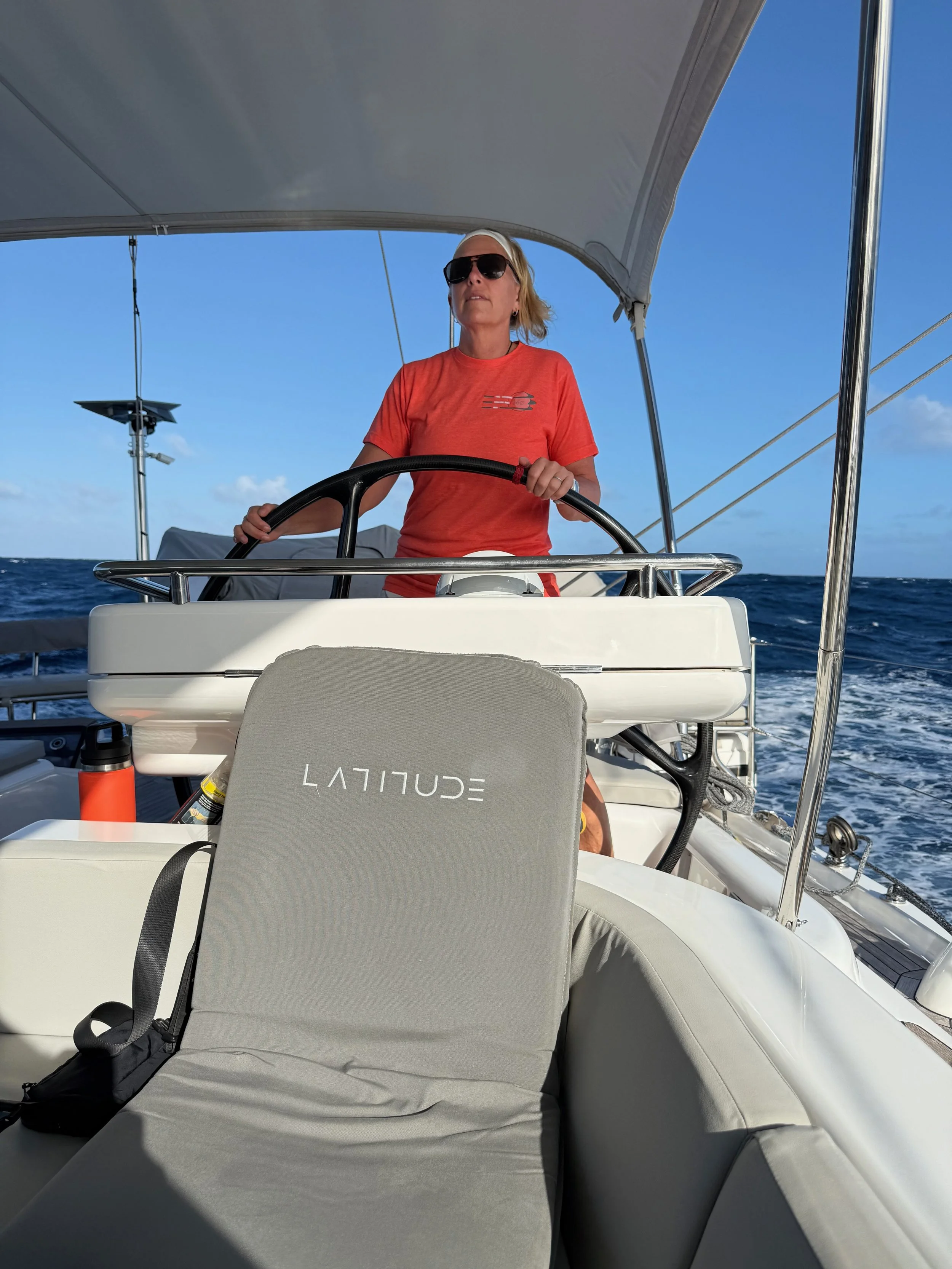
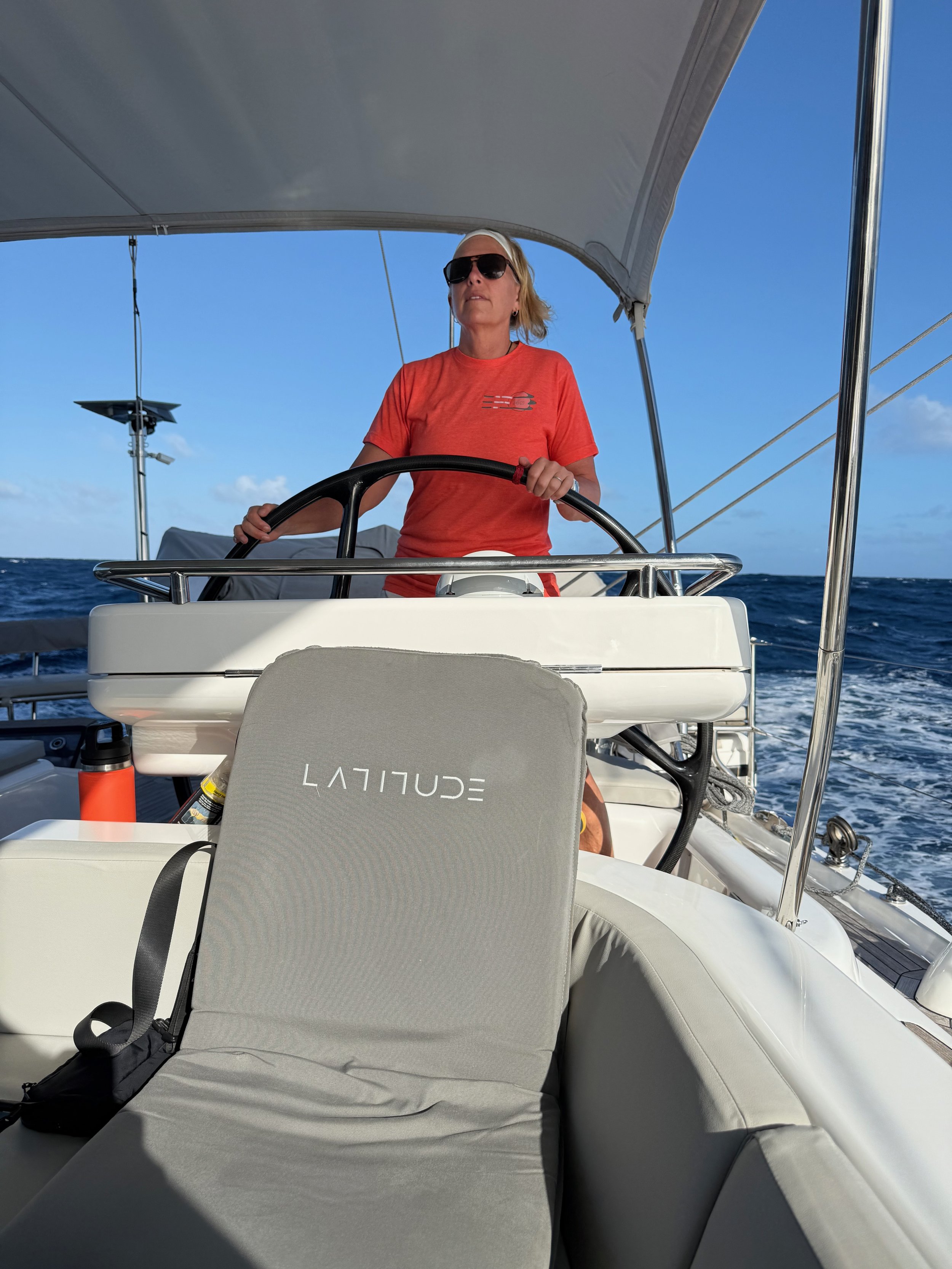
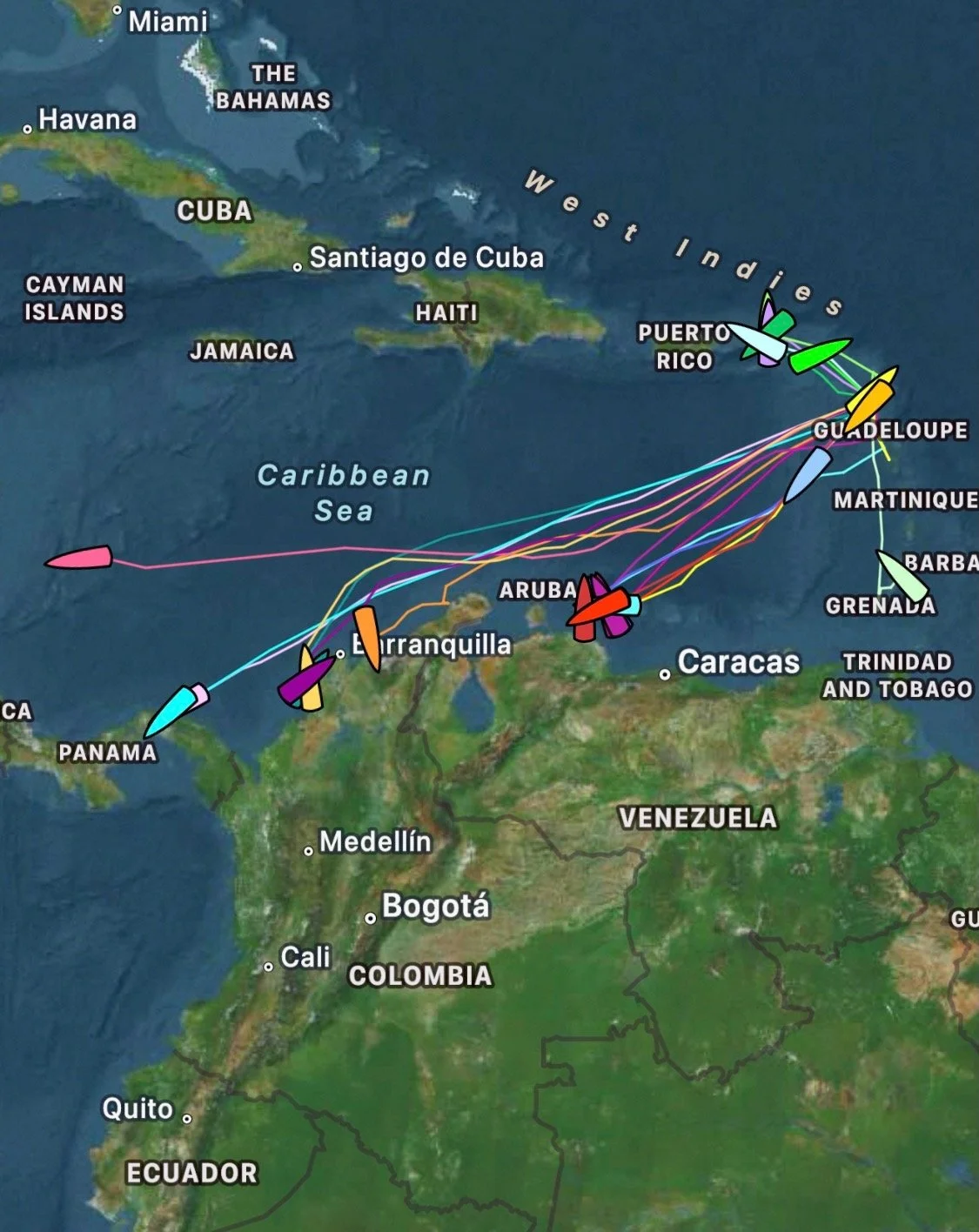
(Dana) On transit, we sail 24-hours per day. No anchoring at night in the middle of the ocean! Our first leg is from Antigua to Isla Providencia off the coast of Nicaragua, 1220 nautical miles, or ~6 days of sailing.
With four people on board – Greg, Dana, Alex, Ellie – we each take 3-hour watches, so 3 hours on and 9 hours off. That means that for 6 hours per day, each of us takes charge of the boat’s navigation, communication, sails, and safety. For this passage, Greg has 5-8am/pm, Ellie 8-11am/pm, Alex 11-2 am/pm, and Dana 2-5am/pm. As the only true night owl of the group, I volunteered for the 2-5 shift. While I’m not super excited about the timing, I am happy to be sandwiched between Alex and Greg. They are great at explaining our settings and how to make sail or course adjustments. I’m still learning but certainly have lots of opportunity to practice. Fortunately, Alex is always available in case the wind shifts or drops, a squall kicks up, or something on the boat just doesn’t sound right. He’d rather be woken up than find us in a difficult situation.
Sunday was our first overnight. After the excitement of Sunday’s start, I had first watch and helped steer us onto our course towards Providencia while the other three set our sails. We settled into a routine for the next 6 days:
Ellie prepared a delicious dinner. Note that Greg would have Hot Pockets the entire time, but Ellie is committed to keeping us healthy. And after a quick rum toast to Neptune, no alcohol on passage. Latitude is a dry boat on passage. Both help with the waistline!
We enjoyed our first sunset over Montserrat while Greg held watch, and we followed the Patriots victory! Then Greg and I tried to get some sleep before our night watches. My alarm was set for 01:30am, as the rule is to be on top 15 minutes before your watch begins.
Sleeping was tough that first night. The seas were rolling, rocking us back and forth in our bed, separated by lee-clothes. I’m not sure why babies enjoy rocking so much; I hated it! Maybe they just cannot voice their objection. I barely slept from 8pm-1am, and then it was my turn.
At 1:45am, I head up top for my 2pm shift. I donned my lifejacket and clipped into one of the D-rings in the Cockpit. Lifejackets are mandatory at night underway. During the day, they are situational.
On watch, we need to remain focused during our 3-hours, looking for wind shifts, listening for issues, checking the horizon and radar for squalls, and identifying boats nearby through AIS. The fun thing about the Oyster World Rally is that the boats we saw on AIS tonight were other rally boats! Usually, AIS shows 900-foot cargo ships carrying thousands of containers or cruise ships with thousands of people—both of which are best to avoid!
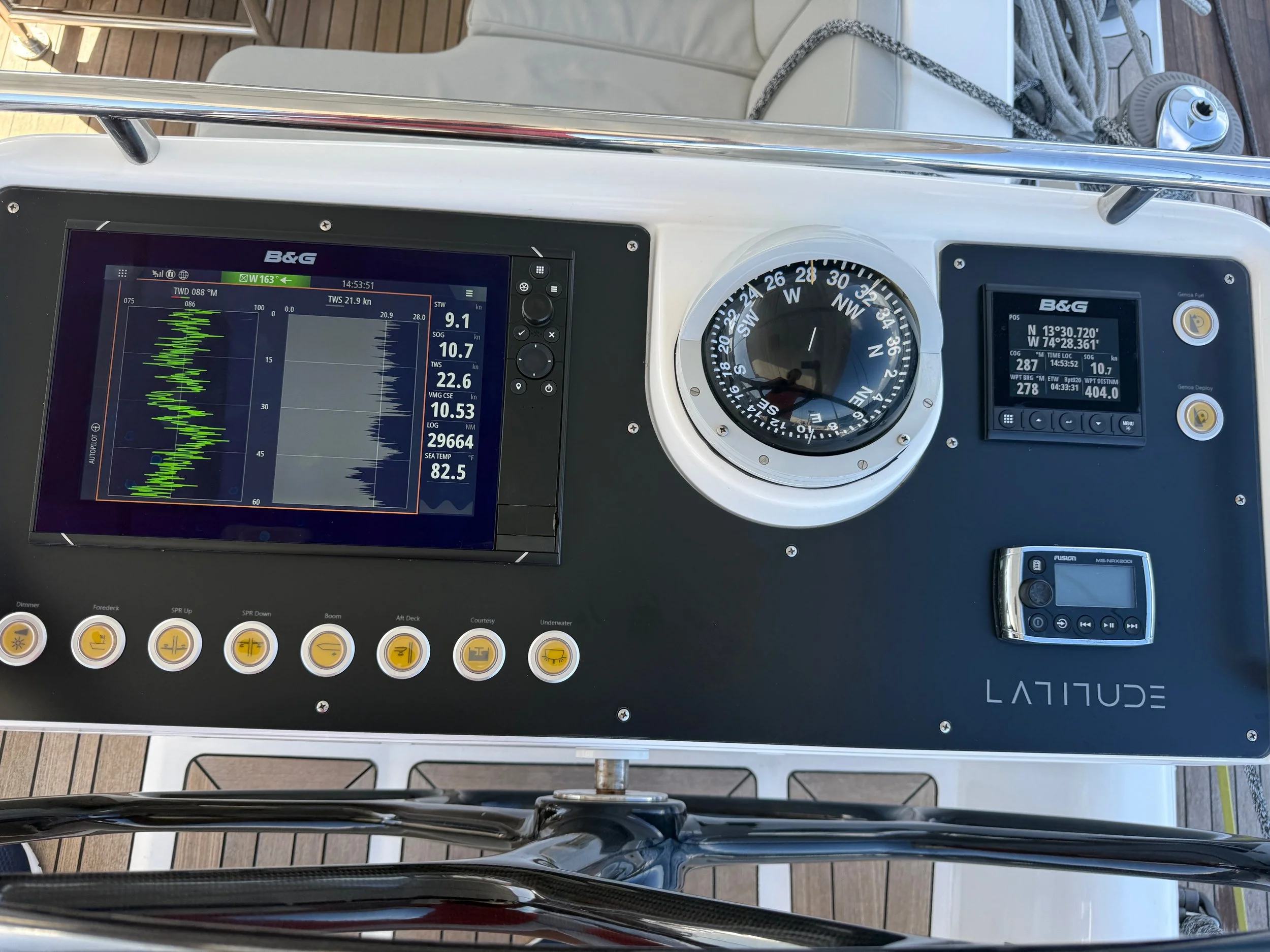
We do not read books as it sucks away your attention, but it is OK to listen to a book on tape through one ear bud. Every hour, we go below to record stats in the logbook: latitude/longitude, wind speed, sea state (height of the waves in meters), velocity, visibility, barometric pressure, battery level, and nautical miles traveled.
Sunday, the stars were outstanding! And Greg and I got to see the lights from a Starlink rocket launch illuminate the sky (although we didn’t find out what it actually was until the following morning… we can appreciate why people think there are UFOs!)
After my shift, I thankfully got a few more hours of sleep. I knew that once I got tired enough, that I’d be able to sleep. The rest of the day felt like a normal day at sea. Although we are spoiled by Ellie’s healthy salad lunches!
Update: Now on day 6, we have settled into our watches. I’m getting better at sleeping from ~9pm-1:30am, then having my watch, then sleeping during Greg’s watch from 5-8am. After that:
Coffee. Work. Lunch. Read. Watch. Dinner. Shower. Read. Sleep. Watch. Sleep. Repeat.
On this point of sail, the boat rocks back and forth continuously, engaging our cores on even the simplest tasks. Beyond that, we each chose a physical challenge for this rally. Greg, Alex, and Ellie are doing 1 pushup or squat per nautical mile sailed or ~27,000 over the 15 months. While I might do a few pushups, I chose squats and sit-ups. So ~27,000 of each over the rally.
This 6-day transit has been a great warm up. It will make the short ones (<4 days) easy. And it gives us some learning for the long ones of the future – 17 days for the Pacific and Indian Oceans and a few other long ones of 10-14 days.
Update before posting: After 3 days in Providencia, we are headed back on the sea to the San Blas. Watch conditions to continue!